The short answer
HEPA stands for “high efficiency particulate air,” a filter definition that the EPA traces to the U.S. Department of Energy: a pleated mechanical filter that can, in theory, capture at least 99.97% of airborne particles 0.3 microns in diameter. “True HEPA” is a marketing phrase that points at that definition; it is not a separate grade. “HEPA-type,” “HEPA-like” and “HEPA-style” are not the definition at all. And even a genuine HEPA filter describes only the filter, not how much air the whole purifier cleans.
Where the definition comes from
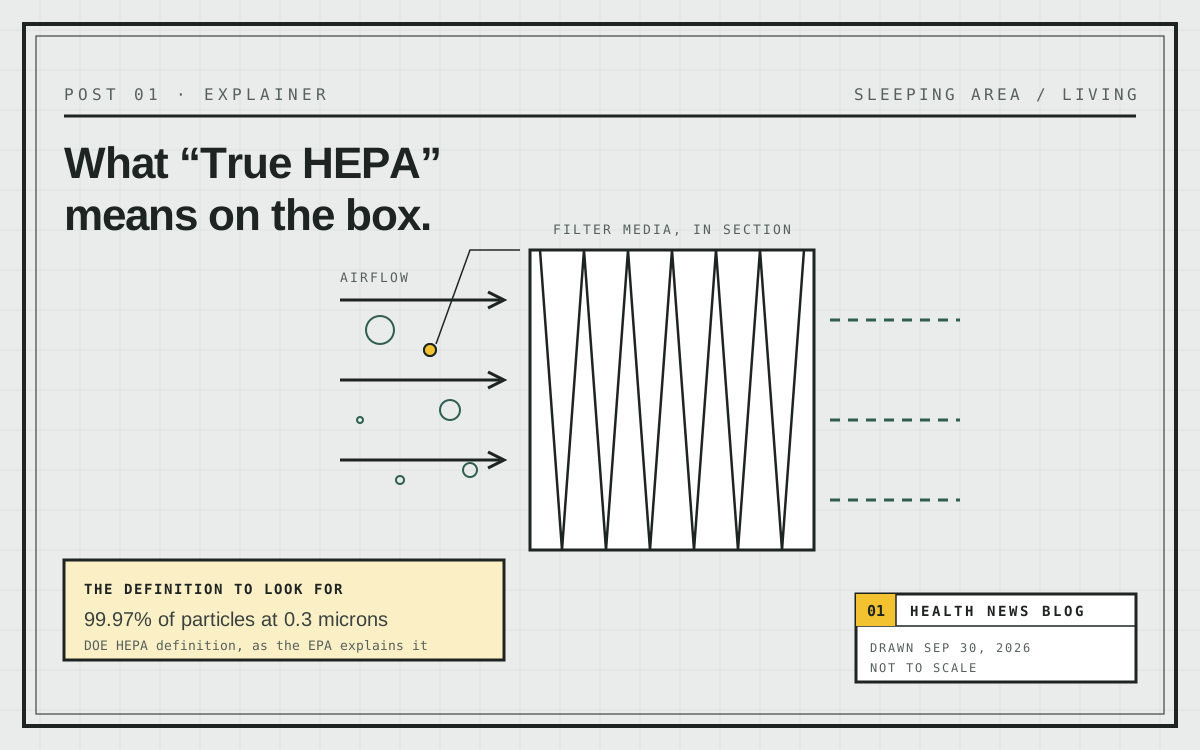
The EPA's plain-language page on HEPA filters describes HEPA as a type of pleated mechanical air filter and says the acronym is “officially defined by the U.S. Department of Energy.” By that definition, the EPA writes, the filter “can theoretically remove at least 99.97%” of dust, pollen, mold and other airborne particles with a size of 0.3 microns.[1] That sentence is the number drawn on this post's cover, and it is the one worth memorizing.
The Department of Energy's version lives in a procurement standard, DOE-STD-3020, “Specification for HEPA Filters Used by DOE Contractors.” The DOE's HEPA Filter Test Facility page lists the current edition as DOE-STD-3020-2015 and describes its purpose as setting specifications and quality-assurance requirements for buying, packaging, shipping and storing HEPA filters.[2] In other words, the definition was written for filters the government buys, not for the box on a store shelf.
The Association of Home Appliance Manufacturers (AHAM), the trade group that runs the CADR certification program for room air cleaners, makes the same point in a 2023 white paper on HEPA test methods: the DOE definition “was not intended for consumer products,” but for filters used in industrial applications, such as air exhaust from nuclear power generation stations.[3] The paper also notes that several national and international standards now classify high-efficiency filters (EN 1822 and ISO 29463 among them), each with its own test conditions and grade names, so “HEPA” can mean slightly different things depending on which standard a maker used.[3]
HEPA is a performance definition for a filter: a stated efficiency at a stated particle size, measured under a test method. A box that uses the word without saying which standard or what efficiency is asking you to take the word on trust.
Why the test particle is 0.3 microns
It is natural to read “99.97% at 0.3 microns” as “catches everything down to 0.3 microns and nothing smaller.” The EPA explains that the opposite is closer to the truth. The 0.3-micron figure “corresponds to the worst case,” the most penetrating particle size, and particles that are larger or smaller are trapped with even higher efficiency.[1] The definition tests the size that is hardest to catch, so the headline figure is a floor, not a cutoff.
For scale, AHAM's consumer page on air cleaner technologies notes that a micron is one millionth of a meter and that a human hair may be between 17 and 180 microns wide.[4]
AHAM's white paper adds one technical wrinkle worth knowing if you read spec sheets closely: the original military test method measured 0.3 microns as a mass median diameter, which is not the same as the count-based size a typical particle counter reports, so a filter “tested at 0.3 microns” with a particle counter can look more efficient than it would under the original method.[3] You cannot check this from a box. It is one more reason to read an unexplained efficiency figure with some caution.
How to read the filter claim on a box, step by step
AHAM's paper observes that terms such as “HEPA-type,” “HEPA-like,” “HEPA-style” and “true HEPA” are frequently used for high-efficiency filters in air cleaners “even though those filters may not truly be HEPA filters.”[3] This sequence sorts the wording from the information.
Find the exact phrase
“HEPA filter” or “True HEPA” is a claim to meet the definition. “HEPA-type,” “HEPA-like,” “HEPA-style” or “HEPA-grade” is a comparison, and a comparison is not a claim to meet anything. Read those as a filter of unstated efficiency.
Look for a number and a particle size together
A meaningful claim reads like “99.97% at 0.3 microns.” A percentage with no particle size, or a particle size with no percentage, does not match the definition and cannot be compared with it.
Look for a named standard or grade
Some makers cite the test standard or a grade name from EN 1822 or ISO 29463. That tells you which rulebook the filter was graded under. No named standard means you are relying on the maker's own description.
Check the CADR label next to it
The filter claim describes the filter alone. The clean air delivery rate describes the whole machine. Read both; our CADR label explainer walks through the second one.
Write down the replacement filter part number
The HEPA claim belongs to the filter that came in the box. A replacement with a different part number is a different product, and its claim needs checking on its own.
A HEPA filter is not the same as a clean-air rating
AHAM puts it bluntly: HEPA efficiency claims refer only to “single pass filter performance in isolation.” Once the filter sits inside a purifier, product design, fan settings and leaks around the filter frame can change how the whole system performs, and air that slips around the filter is not filtered at all.[3] That is why AHAM regards the clean air delivery rate (CADR), which is measured on the complete machine, as the metric for comparing air cleaners, and why the EPA's consumer guide tells shoppers to choose a portable air cleaner with a CADR large enough for the room, noting that such units often reach a high CADR by using a HEPA filter.[3][5]
Two more limits from the EPA's guide. First, a HEPA filter handles particles, not gases; filtering gases and odors takes a separate filter, typically activated carbon, and the EPA notes that the CADR system covers particles only. Second, no air cleaner or filter removes every pollutant in a home; the EPA lists reducing sources and ventilating with clean outdoor air as the most effective steps, with filtration as a supplement.[5]
Replacement is part of the definition in practice
The EPA's guide is short on this point: “All filters need regular replacement,” and a dirty, overloaded filter “won't work well.”[5] AHAM's testing FAQ describes the same signs from the outside: the filter darkens over time and airflow falls as it loads, which is the cue to check the owner's manual for a change or cleaning.[6]
- Note the replacement interval the manual gives, and set a reminder when you install a new filter.
- Price one replacement filter before you buy the purifier, and multiply by the number of changes per year the manual implies; that is the running cost.
- Buy the part number the manual names. AHAM now runs a separate verification program for replacement filters; if a third-party filter carries that mark, it was tested against the original.[7]
- Check which parts the manual says can be vacuumed or rinsed, and do not wash anything it does not name.
An air purifier is a household appliance, not a medical device, and a HEPA filter is a description of filter efficiency, not a health promise. If you have questions about your home's air and your health, ask a clinician or your local health department. For setup, filter changes and placement, follow the manufacturer's manual for your model.
Sources
- U.S. Environmental Protection Agency. What is a HEPA filter? Last updated January 13, 2026. epa.gov
- U.S. Department of Energy, Office of Environment, Health, Safety and Security. High Efficiency Particulate Air (HEPA) Filter Test Facility (FTF), listing DOE-STD-3020-2015, Specification for HEPA Filters Used by DOE Contractors. energy.gov
- Association of Home Appliance Manufacturers. HEPA Filtration – Discussion on Test Methods and Ratings (white paper). April 2023. PDF
- AHAM Verifide. About Air Cleaners (filter technologies). ahamverifide.org
- U.S. Environmental Protection Agency. Guide to Air Cleaners in the Home, 2nd edition. Last updated February 17, 2026. epa.gov
- Association of Home Appliance Manufacturers. Frequently Asked Questions about Testing of Portable Air Cleaners. September 14, 2020. PDF, ahamverifide.org
- AHAM Verifide. Air Filtration Standards (CADR, the 2/3 rule and verified replacement filters). ahamverifide.org
This post is general information, not medical advice. If you have a health concern about your home's air, water or food, ask a clinician or your local health department.