The short answer
CADR, the clean air delivery rate, is a set of three numbers in cubic feet per minute that say how fast a portable air cleaner reduces fine (smoke), medium (dust) and larger (pollen) test particles in a sealed chamber. The test method is ANSI/AHAM AC-1, and AHAM Verifide certifies the results. The suggested room size on the label is worked out from the smoke number. To use it, multiply your room's length by its width and follow AHAM's rule of thumb: the smoke CADR should be at least two-thirds of that area.
What the number actually measures
The Association of Home Appliance Manufacturers (AHAM) describes CADR as the volume of filtered air an air cleaner delivers, with separate scores for tobacco smoke, pollen and dust; the higher the number, the faster the unit filters the air.[1] The EPA's consumer guide calls CADR the rating most portable air cleaners carry and says it is meant to help you pick a unit for the size of the space it will serve.[2]
AHAM's testing FAQ explains how the number is produced. Test particles are released into a chamber of 1,008 cubic feet (roughly 10.5 by 12 feet with an 8-foot ceiling). The particle count is measured first with the air cleaner off, to capture how fast particles settle on their own, and then with it on. CADR is the difference between the two rates multiplied by the chamber volume, so the machine is not credited for particles that would have settled anyway.[3]
| Label line | Test particle (AHAM) | Size range tested |
|---|---|---|
| Smoke | Engineered tobacco smoke | 0.09 to 1.0 microns |
| Dust | Fine test dust | 0.5 to 3.0 microns |
| Pollen | Paper mulberry pollen | 0.5 to 11.0 microns |
Source for the table: AHAM's 2020 testing FAQ.[3] The EPA adds two practical details: the rating is typically measured at the air cleaner's highest speed, and if small particles matter most to you, the smoke number is the one to look at, because smoke stands in for the smallest particles.[2]
CADR measures the whole machine, fan and filter together, on the highest setting. It says nothing about gases or odors: the EPA notes that the CADR system is for particles only.[2]
How to read the label, step by step
The seal is usually on the side or back of the box.[1] Read it in this order.
Confirm it is the AHAM Verifide seal
AHAM's directory page says the seal lists three CADR numbers, one each for tobacco smoke, pollen and dust.[4] A number printed elsewhere on the box without the seal is the maker's own figure, which may or may not come from the same test.
Read the smoke number first
It covers the smallest particles, and the suggested room size is calculated from it.
Read dust and pollen as supporting numbers
They describe medium and larger particles. Two purifiers with the same smoke CADR can differ here, but these two numbers do not feed into the suggested room size.
Read the suggested room size
AHAM's white paper on HEPA gives the conversion it uses: suggested room size in square feet equals the smoke CADR times 1.55, a figure based on reducing fine smoke particles by 80 percent at steady state.[5] The size assumes an 8-foot ceiling.
Look the model up
AHAM keeps a searchable directory of certified room air cleaners that can be searched by CADR, suggested room size, manufacturer and brand.[4] If a model is not there, the label's numbers were not certified through that program.
Measure the room, then do the arithmetic
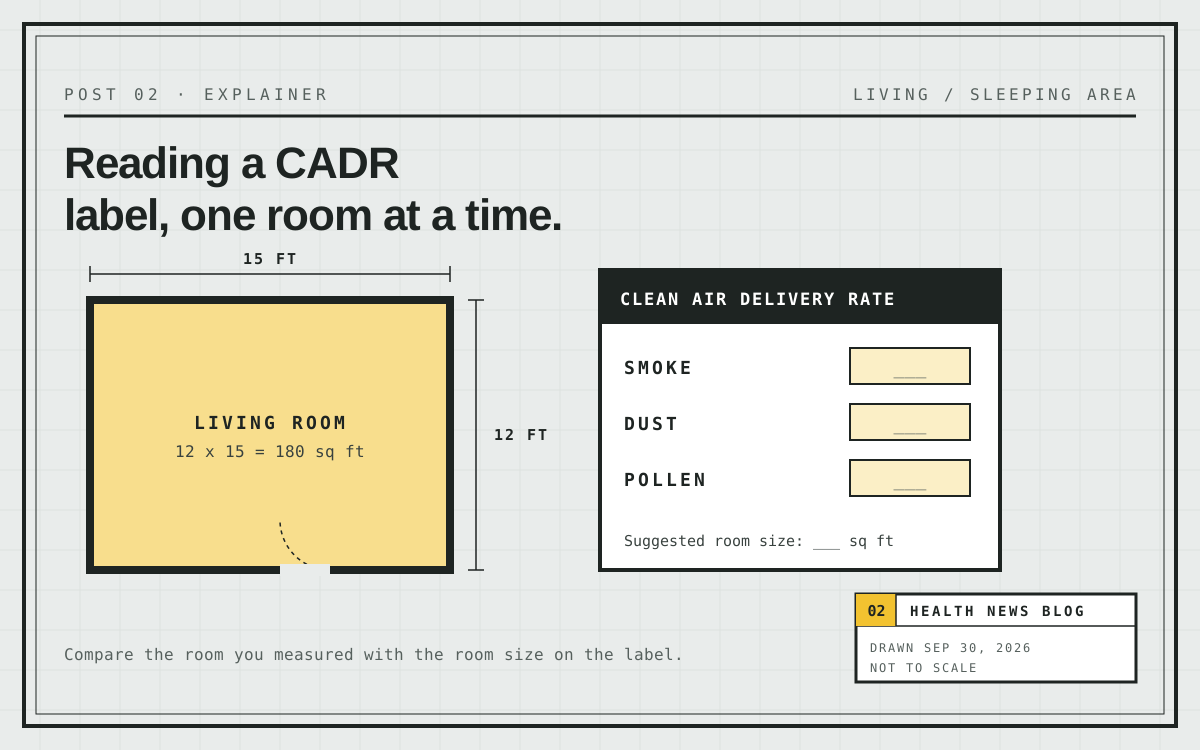
The EPA's instruction is simple: multiply the length and width of the area where the air cleaner will run to get square feet, then compare it with the maximum room size on the packaging.[2] The room on this post's cover is 12 by 15 feet:
- Area: 12 ft × 15 ft = 180 sq ft.
- AHAM's 2/3 rule: smoke CADR of at least two-thirds of 180, which is 120.[1]
- AHAM's room-size formula, run backwards: 180 ÷ 1.55 ≈ 116, so a label showing a suggested room size of 180 sq ft or more corresponds to a smoke CADR of about 116 or higher.[5]
- EPA's sizing chart: it lists a minimum CADR of 65 for 100 sq ft and 130 for 200 sq ft, which works out to about 117 for 180 sq ft.[2]
The three methods land within a few cfm of each other, which is the point: any of them gets you to the right shelf. AHAM notes that a unit with a higher CADR than the room needs will simply clean the air more often and faster.[1]
Adjust for the room you actually have. Both AHAM and the EPA say that ceilings above 8 feet call for a unit rated for a larger room. The EPA adds that in an open floor plan you should count the whole connected space the purifier would serve, and that a space larger than any single unit covers can be handled with more than one.[1][2] For wildfire smoke, AHAM's standards page recommends a smoke CADR equal to the room's square footage, not two-thirds of it.[1]
What the label does not tell you
A CADR label is a good comparison tool and a narrow one. The EPA notes that a portable air cleaner may not reach its rated CADR in every real room, because it competes with surfaces, ventilation and other ways air changes, but the value still lets you compare units against each other.[3] These are the questions to answer somewhere else on the box or in the manual.
- Lower speeds. The rating is measured on high. The EPA notes that an air cleaner filters less air at lower speeds, and that longer run times increase filtration.[2]
- Noise. Some units publish a decibel rating; the EPA gives about 50 dB as roughly the sound of a modern refrigerator. If noise would stop you from running it, weigh this as heavily as CADR.[2]
- Gases and odors. Those take an activated carbon or similar filter; the EPA says there is no widely used rating system for gas removal.[2]
- Filter type and cost. The CADR does not name the filter. Our HEPA explainer covers how to read that claim, and the running cost is the replacement filter times the changes per year.
- Energy use. An ENERGY STAR label is about energy efficiency only; the EPA says it does not refer to air-cleaning effectiveness in any way.[2]
A note on ozone, ionizers and California's list
Some purifiers add an ionizer or another electronic stage alongside the filter. The EPA's guide says to avoid air cleaners that intentionally produce ozone, which it calls a lung irritant, and notes that units with electrostatic precipitators, ionizers, UV lamps without adequate coatings or plasma stages may have the potential to emit it. The same guide says that both the California Air Resources Board (CARB) and AHAM maintain lists of air cleaners that have been tested and shown to emit little or no ozone.[2] The EPA's separate page on ionizers adds that ion generators may do little for larger particles such as pollen and house dust, and do not remove gases or odors.[6]
What to take from that for the box in your hand: if the unit has an ionizer or similar feature, check whether the manual lets you switch it off, and look for the model on CARB's list of certified air cleaning devices. CARB's own pages refused our automated requests on September 30, 2026, so we point to the EPA's summary here rather than quoting CARB directly.
A CADR is a laboratory comparison number for a household appliance, not a health rating, and an air purifier is not a medical device. If you have questions about your home's air and your health, ask a clinician or your local health department. For placement, speeds and filter changes, follow the manufacturer's manual; the EPA's general advice is to keep the unit where you spend the most time and clear of curtains or anything that blocks airflow.[2]
Sources
- AHAM Verifide. Air Filtration Standards (CADR and the 2/3 rule). ahamverifide.org
- U.S. Environmental Protection Agency. Guide to Air Cleaners in the Home, 2nd edition. Last updated February 17, 2026. epa.gov
- Association of Home Appliance Manufacturers. Frequently Asked Questions about Testing of Portable Air Cleaners (quoting the EPA's Residential Air Cleaners technical summary). September 14, 2020. PDF, ahamverifide.org
- AHAM Verifide. Find a Certified Room Air Cleaner (directory page). ahamverifide.org
- Association of Home Appliance Manufacturers. HEPA Filtration – Discussion on Test Methods and Ratings (white paper, section 1.2 and footnote 7). April 2023. PDF
- U.S. Environmental Protection Agency. What are ionizers and other ozone generating air cleaners? Last updated February 18, 2026. epa.gov
This post is general information, not medical advice. If you have a health concern about your home's air, water or food, ask a clinician or your local health department.