The short answer
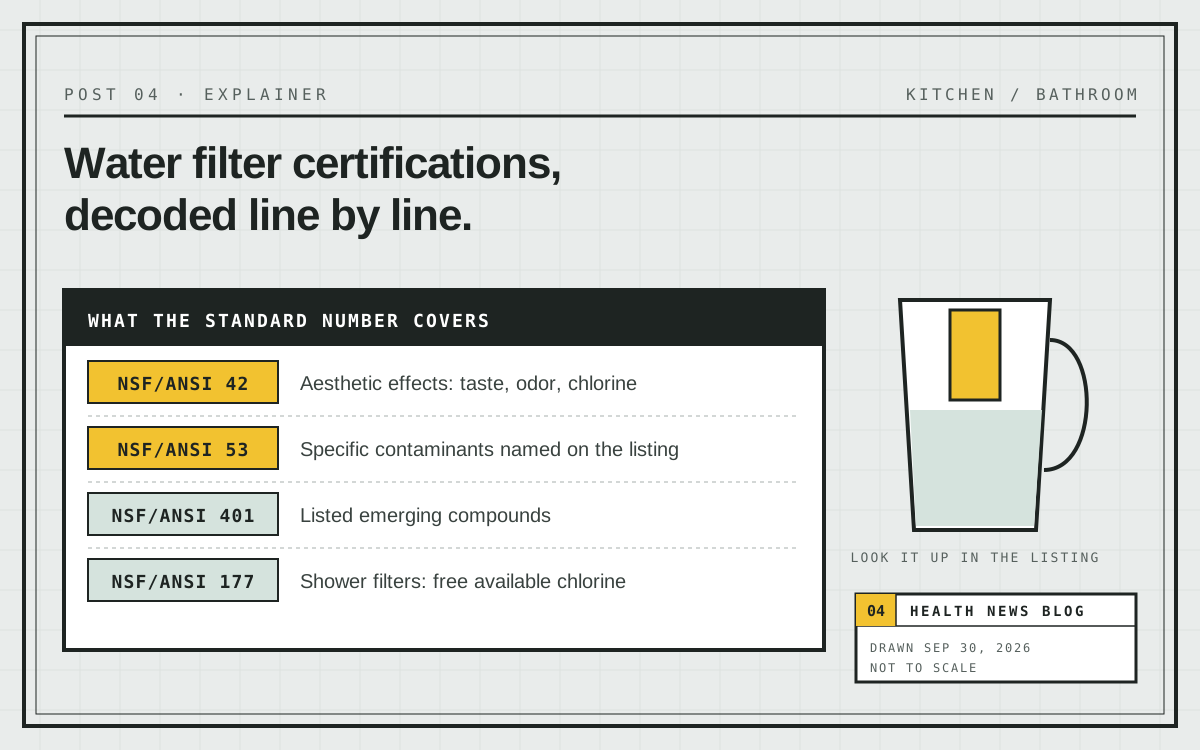
NSF/ANSI 42 covers aesthetic effects such as chlorine, taste and odor. NSF/ANSI 53 covers specific health-related contaminants, and a product is certified only for the ones named on its listing. NSF/ANSI 401 covers a set of listed emerging compounds, and NSF/ANSI 177 covers shower filters, where the only claim in NSF's search is free available chlorine reduction. A certification means an accredited certifier lists that exact model for those exact claims; “tested to” the same standard is the maker's own statement. The way to tell them apart is to look the model up.
What each standard number covers
NSF's public search page for drinking water treatment units lists the standards by number and name, and each standard comes with its own menu of reduction claims a product can be certified for.[1] The table uses NSF's own names and claim lists as they appeared on September 30, 2026.
| Standard | NSF's name for it | Examples of claims in NSF's search |
|---|---|---|
| NSF/ANSI 42 | Drinking Water Treatment Units – Aesthetic Effects | Chlorine, chloramine, taste and odor, nominal particulate, zinc |
| NSF/ANSI 53 | Drinking Water Treatment Units – Health Effects | Lead, cysts, PFOA and PFOS, total PFAS, trihalomethanes, VOCs, mercury, many individual chemicals |
| NSF/ANSI 58 | Reverse Osmosis Drinking Water Treatment Systems | TDS, fluoride, nitrate/nitrite, arsenic, lead and others |
| NSF/ANSI 401 | Drinking Water Treatment Units – Emerging Compounds/Incidental Contaminants | Bisphenol A, DEET, microplastics, several pharmaceuticals and pesticides |
| NSF/ANSI 177 | Shower Filtration Systems – Aesthetic Effects | Free available chlorine reduction (the only claim listed) |
The same page lists other programs too, including water softeners (NSF 44), ultraviolet systems (NSF 55) and distillation systems (NSF 62).[1] Two details in the claim lists are worth noticing. First, chlorine and taste-and-odor claims appear under both 42 and 53, so the standard number alone does not tell you which claims a product holds. Second, a shower filter certified to 177 is certified for one thing, chlorine, and nothing on that listing speaks to anything else.
The EPA's home water filtration fact sheet explains the split between the two families: ANSI/NSF standards come in one set for health concerns, such as removing specific contaminants, and one for aesthetic concerns, such as taste or appearance, and a certification is tied to one or both.[2]
A standard number is a category, not a result. What a filter is certified to do is the list of claims printed on its row of the listing, and nothing more.
“Certified” versus “tested to”
The EPA's fact sheet says each ANSI/NSF standard requires verification of contaminant reduction claims, an evaluation of the unit including its materials and structural integrity, and a review of product labels and sales literature. It describes NSF's program as requiring extensive product testing and unannounced audits of production facilities, and it names NSF, UL and the Water Quality Association as the ANSI-accredited organizations that certify to these standards (the fact sheet is an older EPA publication, still posted).[2]
That is what the word “certified” carries when it is backed by a listing. Box copy such as “tested to NSF/ANSI 42” or “meets NSF standards” can describe the maker's own lab work or a one-time test, with no listing and no ongoing audit. It may be accurate, but it is not the same claim. The EPA's advice for that case is direct: if a unit is not certified by one of these organizations, contact the manufacturer and ask for proof of its claims.[2]
The Water Quality Association runs its own certification, the Gold Seal, which it describes as the oldest third-party testing and certification program in the water treatment industry, and it keeps a public listing of products and components that have earned the mark after passing testing and annual facility audits.[3][4] A WQA Gold Seal listing is a valid certification in its own right; check it in WQA's directory rather than NSF's.
How to look a product up, step by step
This takes about five minutes and settles most questions about a box.
Write down the exact model and the cartridge number
Listings are by model and replacement element. A pitcher body and its filter can be listed separately, and a brand can sell several cartridges that look alike.
Open the certifier's own search
For NSF, that is the drinking water treatment unit listings at info.nsf.org; for a WQA Gold Seal, WQA's product directory.[1][4] Search by manufacturer or by brand and model. The listed manufacturer is sometimes a parent company with a different name from the brand on the box.
Find the row and read every column
An NSF listing row shows the brand and model, the replacement element, the rated service cycle in gallons, the flow rate and the claims. When we opened listings on September 30, 2026, the page stated they were current as of 12:15 a.m. Eastern that day and advised confirming any listing with NSF.[5]
Read the footnotes
Footnotes change the meaning of a row. In the listings we opened, some entries carried notes such as “Conforms to material requirements only,” which, as written, covers the materials the part is made of rather than any reduction claim.[5]
Match the claim to your reason for buying
If you want better-tasting tap water, a 42 chlorine and taste-and-odor claim fits. If you have a specific contaminant in mind, it has to appear by name on the 53, 58 or 401 row for that model.
Why the claims say “reduction”
Nearly every contaminant claim in NSF's search is written as a reduction: “Chlorine Reduction,” “Lead Reduction,” “Free Available Chlorine Reduction.” (The few exceptions, such as “Bacteriostatic Effects” under 42, describe something other than a contaminant.)[1] A certified filter lowers the listed contaminant under the test conditions; it does not promise zero, and it covers nothing that is not on the list. The CDC's page on home water treatment makes the same practical point from the buyer's side: different systems handle different contaminants, so test your water, then check the system's label to confirm it addresses what you are concerned about.[6]
The rated service cycle matters for the same reason. The EPA notes that activated carbon filters are designed to filter a certain amount of water, after which they clog and stop working, and advises following the maker's replacement schedule and checking the cost of replacement filters before you buy.[2] A certified cartridge used past its rated gallons is outside the conditions it was certified under.
- Get your utility's annual water quality report (sometimes called a consumer confidence report) before choosing a filter; the EPA suggests starting there.[2]
- Confirm the certification in the certifier's listing, not on the box or a seller's page.
- Note the rated service cycle in gallons and turn it into weeks for your household.
- Price the replacement cartridge; it is the running cost of the product.
- For a shower filter, expect a 177 listing to speak to chlorine only.
Water filters are household products, not medical devices, and a certification describes contaminant reduction under test conditions, not a health outcome. If you have a concern about what is in your water, your water utility or local health department can tell you what has been measured and what to do about it. Change cartridges on the schedule in the manufacturer's manual.
Sources
- NSF. Search for NSF Certified Drinking Water Treatment Units, Water Filters (standards and claims menus). Accessed September 30, 2026. info.nsf.org
- U.S. Environmental Protection Agency. Water Health Series: Filtration Facts (home drinking water filtration fact sheet, PDF). epa.gov; landing page: epa.gov
- Water Quality Association. Product Certification (Gold Seal program). wqa.org
- Water Quality Association. Find WQA Certified Products. wqa.org
- NSF. Drinking water treatment unit listings, example search by manufacturer. Accessed September 30, 2026. info.nsf.org
- Centers for Disease Control and Prevention. About Home Water Treatment Systems. Last reviewed April 10, 2024. cdc.gov
This post is general information, not medical advice. If you have a health concern about your home's air, water or food, ask a clinician or your local health department.