The short answer
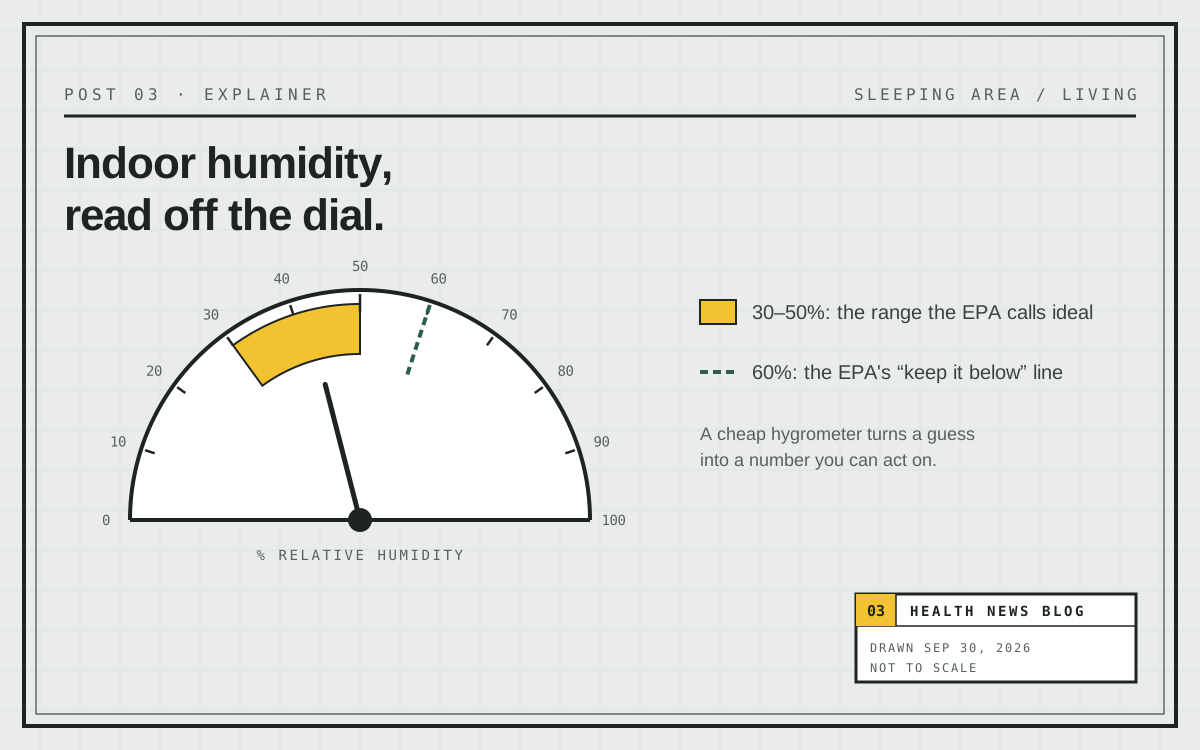
Relative humidity is how much water vapor the air holds compared with the most it could hold at that temperature, written as a percentage. The EPA's guidance on moisture in the home says to keep indoor relative humidity below 60 percent, ideally between 30 and 50 percent, and its humidifier guidance says not to humidify above 50 percent. A hygrometer is the inexpensive instrument that turns that range into a number you can check, and a humidifier that runs to reach it needs cleaning every few days.
What relative humidity is
The National Weather Service defines relative humidity as a ratio, expressed in percent, of the moisture actually in the air relative to the amount that would be there if the air were saturated. Because the saturated amount depends on temperature, the NWS notes, relative humidity is a function of both moisture and temperature, and on its own it does not tell you the actual amount of water in the air.[1]
That second sentence explains most of the confusing readings people get at home. Warm air can hold more water vapor than cool air, so the same air reads as a lower percentage in a warm room and a higher one in a cool room, even though nothing was added or removed. A hygrometer by a sunny window and one in a cool corner of the same room can disagree for exactly this reason. It also explains why humidity often reads low in winter: cold outdoor air brought indoors and warmed ends up at a low relative humidity.
Where the 30–50% range comes from
The range drawn on this post's cover is the EPA's. Its Brief Guide to Mold, Moisture and Your Home says: keep indoor humidity below 60 percent, ideally between 30 and 50 percent relative humidity.[2] The EPA's mold course repeats the same numbers and frames them as a building question: humidity in the air can supply enough moisture for mold to grow on surfaces, which is why the agency files it under moisture control.[3]
The EPA's page on home humidifiers sets the upper limit from the other direction: do not humidify to indoor relative humidity above 50 percent, because higher levels can encourage the growth of biological organisms in the home.[4] So the two documents agree. Below 30 percent is dry air, 30 to 50 is the target band, 50 is where a humidifier should stop pushing, and 60 is the line to stay under.
The EPA also names a free visual check: condensation on windows, walls or pipes. Its guide calls condensation a possible sign of high humidity and says to dry the surface and reduce the moisture source quickly.[2] If your hygrometer says 45% and the windows are streaming every morning, trust the windows and check the meter.
How to take a reading you can trust, step by step
The EPA describes a humidity meter as a small, inexpensive instrument, roughly $10 to $50, sold at many hardware stores.[2] This is how we would set one up.
Put it where you spend time, at about table height
You want the air you live in, not the air at a vent. Keep it out of direct sun, away from a heating or cooling register, and out of the mist path of a humidifier; each of those changes the reading right next to the sensor, not the room.
Let it settle before believing it
After you move a hygrometer, give it time to match the new spot before reading. A number that is still drifting is not a reading yet.
Read it at the same times each day
Morning and evening readings for a week tell you more than a single glance. Cooking, showers and drying laundry push humidity up for a while; so does a crowd in the living room.
Check it against a known value once
A saturated salt solution holds the air above it at a fixed humidity. The National Bureau of Standards (now NIST) published the value for table salt as 75.3 percent at 25°C (77°F), with a stated uncertainty of 0.12 percentage points.[5] Put a small dish of table salt dampened with a little water (wet, not dissolved) in a sealed container with the hygrometer at a steady room temperature, and leave it until the reading stops changing, which can take several hours.
Compare the result with the stated accuracy
If the maker states an accuracy of, say, plus or minus a few percent, a reading within that distance of 75 is behaving as specified. If it is further off, note the offset and correct your daily readings by it, or use the calibration setting if the model has one.
If you add moisture: the humidifier routine
When a hygrometer shows dry air and you run a humidifier, the EPA's care guidance is specific. It notes that ultrasonic and impeller (“cool mist”) humidifiers are the types that generally disperse the most microorganisms and minerals from their tanks into the air, which is why cleaning matters most for them.[4]
- Daily: unplug it, empty the tank, wipe all surfaces dry and refill with fresh water.[4]
- Every third day: clean the tank with a brush, removing scale, deposits or film, and wipe everything dry.[4]
- Cleaning agent: follow the maker's instructions; if there are none, the EPA suggests a 3% hydrogen peroxide solution on surfaces that touch water, then several rinses with tap water.[4]
- Water: use water with low mineral content, such as bottled water labeled “distilled.” The EPA says minerals in tap water cause scale inside the unit and can show up as a “white dust” on nearby surfaces.[4]
- Setting: if water condenses on windows, walls or pictures, move the humidifier, lower its setting or run it less; do not let carpet, drapes or tablecloths near it get damp.[4]
- End of season: clean it, dry every part, discard used cartridges or filters, and store it dry; clean it again before the next use.[4]
If humidity is too high rather than too low, the EPA's moisture guide points the other way: vent moisture-producing appliances such as clothes dryers and stoves outdoors where possible, and use air conditioning or a dehumidifier when needed.[2]
What a single reading cannot tell you
A hygrometer measures the air around it at that moment. It is a good guide and a limited one.
- It does not see a wet wall, a leak under a sink or a damp crawl space; the EPA's mold guidance is about fixing water sources, and humidity is only one of them.[3]
- It reads one spot. A room with a cold exterior wall or a closet can be damper than the number on the table.
- It drifts. Re-check it against the salt test once a season or whenever the readings stop making sense.
- It does not say anything about air quality in general; it measures water vapor and, on most models, temperature.
Hygrometers and humidifiers are household appliances, not medical devices, and a humidity number is a home-maintenance reading, not a health measure. The EPA's humidifier guidance advises stopping use and contacting a physician if you notice breathing problems you connect with using a humidifier.[4] For anything else about your home's air and your health, ask a clinician or your local health department, and follow each manufacturer's manual for setup and cleaning.
Sources
- National Weather Service. Glossary: relative humidity. weather.gov
- U.S. Environmental Protection Agency. A Brief Guide to Mold, Moisture and Your Home. Last updated February 18, 2026. epa.gov
- U.S. Environmental Protection Agency. Mold Course, Chapter 2: Why and Where Mold Grows. Last updated December 1, 2025. epa.gov
- U.S. Environmental Protection Agency. Use and Care of Home Humidifiers. Last updated April 29, 2026. epa.gov
- Greenspan L. Humidity fixed points of binary saturated aqueous solutions. Journal of Research of the National Bureau of Standards, Section A. 1977;81A(1):89–96 (Table 2, sodium chloride). PubMed Central
This post is general information, not medical advice. If you have a health concern about your home's air, water or food, ask a clinician or your local health department.